
Jump to the content
- {{#headlines}}
- {{title}} {{/headlines}}

Contact
Press, Communications and Marketing
Tel.: +49 228 833-144
Fax: +49 228 833-441
presse[at]avh.de
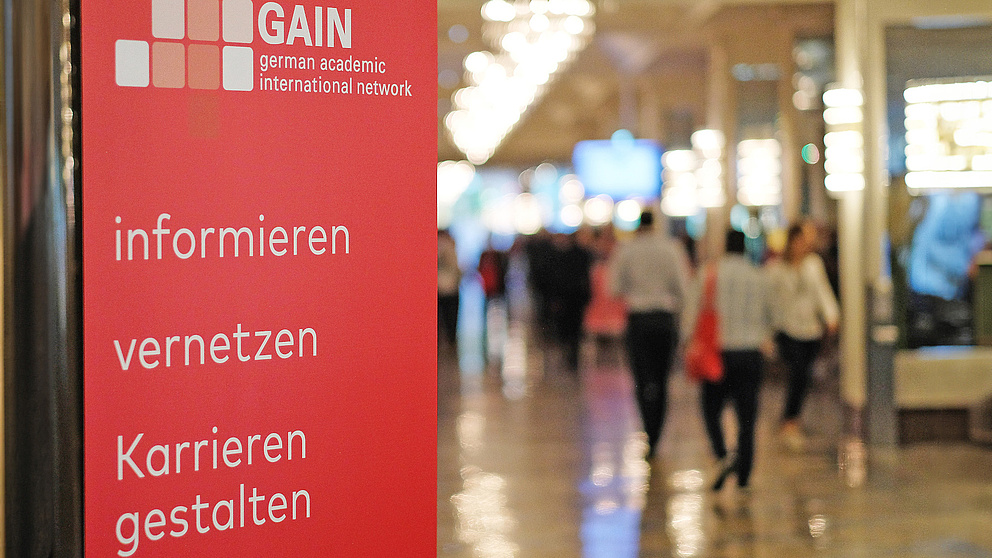
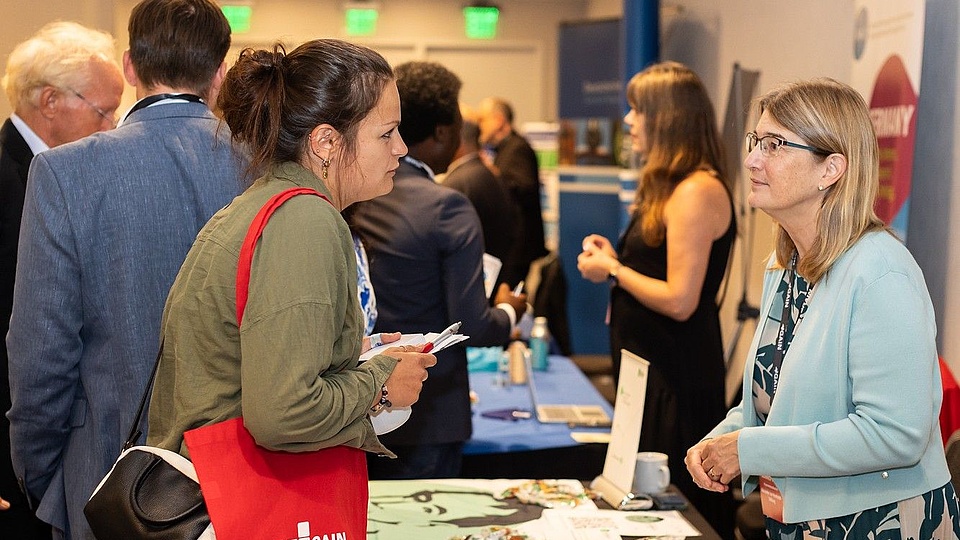
Whether it’s career paths leading to a professorship, a move into research management, careers at universities of applied sciences, or leading a junior research group: for three days at the end of August, the GAIN conference will focus entirely on Germany as a centre for research. At this joint event organised by the German Academic Exchange Service (DAAD), the Alexander von Humboldt Foundation and the German Research Foundation (DFG) in San Francisco, postdoctoral researchers will receive in-depth advice on career planning at German universities, research institutions or in the research-intensive private sector. More than 35 workshops will cover topics such as the Excellence Strategy, resilience in academia, and generative AI, or offer insights into appointment procedures. The GAIN conference also includes the annual ‘Talent Fair’, at which nearly 80 German research institutions will this year present career opportunities and advertise vacancies. In addition, the DAAD, the DFG and the Humboldt Foundation will provide information on their programmes for researchers at the early stages of their careers. As always, alongside information and networking, GAIN26 will also feature entertaining science communication: in a Science Slam, postdocs will present selected aspects of their research findings.
Distinguished guests
On 21 August, the presidents of the three organisations will open the GAIN conference following a welcome address by the Federal Ministry of Education and Research. High-ranking representatives from the worlds of science and politics will be attending, including a delegation from the Bundestag Committee on Research, Technology, Space and Technology Assessment, as well as eight science ministers from several federal states. Over the course of the three-day event, representatives from politics, universities, funding organisations and non-university research institutions will be on hand to answer participants’ questions.
The GAIN conference is once again proving highly popular: around 500 people have already registered. In addition to the in-person event, GAIN is also offering a digital workshop on 17 September, aimed at interested postdocs worldwide.
The German Academic International Network
The German Academic International Network (GAIN) is the network for German researchers working around the world. Since 2003, GAIN has been supporting researchers through a diverse programme of activities designed to maintain links with German research institutions, prepare researchers for a return to Germany as a centre of research, and help them articulate their interests to policy-makers. GAIN is a joint initiative of the Humboldt Foundation, the DAAD and the DFG, and is funded by the Federal Ministry of Research, Technology and Space. Associate members include the Fraunhofer-Gesellschaft, the Helmholtz Association, the Leibniz Association, the Max Planck Society, the German Rectors’ Conference, the German National Academic Foundation and German Cancer Aid. Other partners from academia, industry and politics regularly support GAIN’s work.
GAIN Programme
GAIN26 will take place from 21 to 23 August at the Marriott Marquis San Francisco Hotel. Information on the network can be found at www.gain-network.org/en. You can find the conference programme here.
Please direct any questions to:
Anna Oberle-Brill
GAIN Programme Director
oberle-brill[at]daad.de
+1 (212) 758-3223-217
(please note the time difference of minus 6 hours (New York) or minus 9 hours (San Francisco))
Press contacts
Humboldt Foundation
Kristine Logemann
Head of Press, Communications & Marketing
+49 228 833-144
presse[at]avh.de
DAAD
Michael Flacke
Press Officer
+49 228 882-454
presse[at]daad.de
DFG
Marco Finetti
Press Officer
+49 228 885-2109
presse[at]dfg.de
Every year, the Alexander von Humboldt Foundation enables more than 2,000 researchers from all over the world to spend time conducting research in Germany. The Foundation maintains an interdisciplinary network of well over 30,000 Humboldtians in more than 140 countries around the world – including 64 Nobel Prize winners.