
Jump to the content
- {{#headlines}}
- {{title}} {{/headlines}}

Contact
Press, Communications and Marketing
Tel.: +49 228 833-144
Fax: +49 228 833-441
presse[at]avh.de
Accelerator Physics
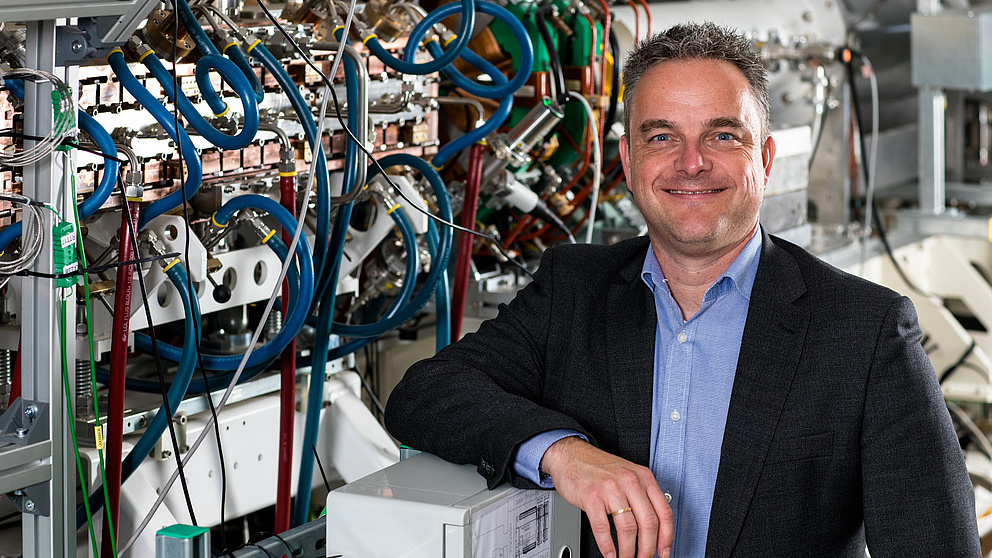
In particle accelerators, charged particles, such as electrons and protons, are driven to high speeds, bundled into beams and guided by magnets along a predetermined path. In order to precisely control these beams, their position, form, intensity and energy must be measured as exactly as possible. Carsten Welsch is an expert on beam diagnostics and develops measuring methods that impact the particle beam as little as possible. They help to operate accelerators more reliably and efficiently and to open up new technical opportunities. His research findings are used, for example, at the world’s largest particle accelerator, the Large Hadron Collider, at CERN in Switzerland where Welsch has headed the development of the Beam Gas Curtain Monitor for 20 years.
Carsten Welsch’s research is not only relevant with regard to fundamental research but also to medicine, for example in radiation therapy for cancer or in imaging. In his role as coordinator of the European research project, “Optimization of Medical Accelerators” (OMA), he worked on improving medical accelerators and their diagnostic processes. In order to evaluate measurement data and optimise accelerator facilities, he employs machine learning, artificial intelligence and automation.
As a Humboldt Professor at KIT, Carsten Welsch is invited to lead the new organisational unit for “sustainable accelerators” in the Institute for Beam Physics and Technology (IBPT). Its goal is to develop accelerator systems whose design, operation and modernisation not only take scientific performance into account but also energy consumption, life-cycle costs and environmental impacts.
Brief bio
Since 2008, Carsten Welsch has been a professor at the University of Liverpool, United Kingdom. Having completed his doctorate in accelerator physics at Frankfurt am Main in 2002, he held postdoc positions at the MPI for Nuclear Physics in Heidelberg and CERN in Geneva, Switzerland. He then headed a junior research group at the GSI Helmholtzzentrum für Schwerionenforschung in Darmstadt. For his work on FLASH proton therapy, he received the 2021 Galileo Galilei Award in Medical Physics and in 2026, he was part of the Beam Gas Curtain Collaboration team that was granted the Faraday Cup Award.
Carsten Welsch has been selected for a Humboldt Professorship and is currently conducting appointment negotiations with the German university that nominated him for the award. If the negotiations end successfully, the award will be granted in 2027.