
Jump to the content
- {{#headlines}}
- {{title}} {{/headlines}}

Contact
Press, Communications and Marketing
Tel.: +49 228 833-144
Fax: +49 228 833-441
presse[at]avh.de
Quantum optics
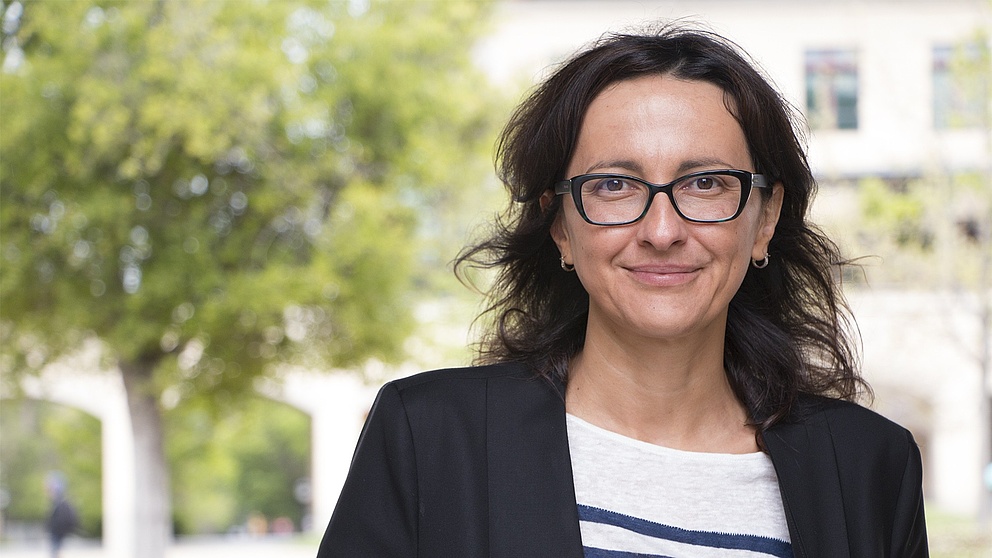
Microchips are the basis of our modern electronics and are used in nearly all areas of life. In her research, Jelena Vučković explores experimental photonics and quantum optics. She develops photonic systems for classic and quantum optical applications on chips. Her goal is to miniaturise optical systems for applications ranging from mobile phones and wearables via augmented reality through to quantum computers and secure quantum communication.
The pioneering work of Vučković’s group on the inverse design of photonic systems, in particular, has set new standards and very significantly driven chip-based quantum photonics. What was fundamental research 20 years ago is now also used by industry to design photonic chips. It is a new approach and a software tool that uses algorithms to discover the optimum chip design for a previously determined task. This AI-supported method performs the necessary calculations much faster than conventional simulation tools. Now, a spin-off from Vučković’s lab is refining this successful software yet further.
The aim is not only to produce faster chips but more energy-efficient, sustainable ones. Photons transport data faster than the electrons in conventional chips and generate less heat. So, the kind of large computer centres for AI applications that are emerging all over the world require less power and less cooling.
In her role as a Humboldt Professor, Jelena Vučković is invited to head the yet to be founded Photonics Research Institute for novel computing SysteMs (PRISM) that is being established jointly by TUM and the MPI of Quantum Optics. It is supposed to play a pioneering role internationally and establish photonics for artificial intelligence and neuromorphic computers – built on the model of biological neural networks – at the Munich research hub.
Brief bio
Since 2013, Jelena Vučković has held a professorship in electrical engineering at Stanford University, United States. After studying applied physics in Niš, today’s Serbia, she took her Ph.D. at California Institute of Technology (CALTECH) in 2002, transferring to Stanford as a postdoc and subsequently, assistant and tenured associate professor. From 2018 to 2021, she was the founding director of the Quantum Fundamentals, ARchitecture and Machines (Q-FARM) initiative which is dedicated to expanding the university’s strengths in quantum science and technology as well as training the next generation of researchers. Vučković has received numerous awards, including the 2007 US Presidential Early Career Award for Scientists and Engineers (PECASE), the 2010 Humboldt Research Award, the 2025 Zeiss Research Award and the 2026 R. W. Wood Prize awarded by Optica.
Jelena Vučković has been selected for a Humboldt Professorship and is currently conducting appointment negotiations with the German university that nominated her for the award. If the negotiations end successfully, the award will be granted in 2027.