
Jump to the content
- {{#headlines}}
- {{title}} {{/headlines}}

Contact
Press, Communications and Marketing
Tel.: +49 228 833-144
Fax: +49 228 833-441
presse[at]avh.de
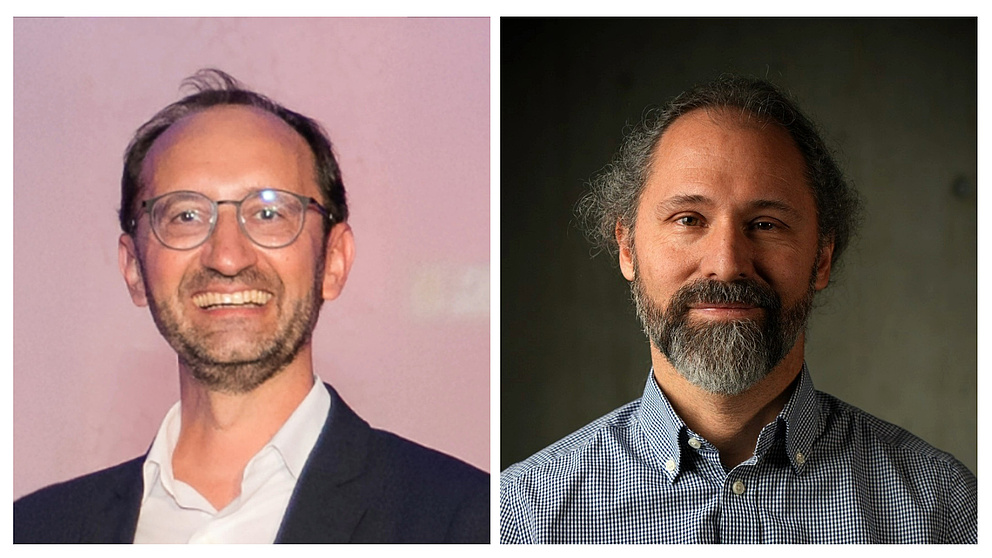
Thomas Becher, Elementary Particle Physics
Thomas Becher conducts research at the University of Bern and is one of the world’s leading scientists in the field of theoretical elementary particle physics. Through their originality, his ground-breaking contributions in several areas of modern particle physics research have shaped development in this field. He provides theoretical studies, in which he investigates the fundamental interactions of matter, to support the experiments conducted at the Large Hadron Collider (LHC) operated by the European Council for Nuclear Research (CERN).
Thomas Becher was nominated by the Johannes Gutenberg University of Mainz. He intends to use his planned research stays with Matthias Neubert in Mainz and Martin Beneke at the Technical University of Munich to delve deeply into the problem of factorization. This work will aim to cleanly split the complex processes involved in proton collisions into two parts: one part that shows how the elementary components in protons are distributed and one part that describes what happens when these components collide. Becher wants to prove that this factorization also applies to more complex measurable variables which dissolve the detailed structure of the collision. This research will lay the foundation for making predictions about the processes occurring in the LHC and will thus play an important role in the search for “new physics” beyond the standard model of elementary particle physics.
Gustau Camps-Valls, Machine Learning/Earth Sciences
Gustau Camps-Valls is a professor of electronic engineering at the Universitat de València and a pioneer in the use of artificial intelligence for Earth observation. He has been a major force in the development of discipline-specific AI where he combined machine learning with physical laws to improve predictive modelling of complex systems. Organisations and climate scientists around the world have adopted his methods. For example, his algorithms for machine learning are used by the European Space Agency ESA and weather centres for processing satellite data and for data fusion.
He was nominated by the Max Planck Institute for Biogeochemistry in Jena. During his research stays in Germany, he wants to work with his host Markus Reichstein to tackle topical research questions along the interface between AI and climate. One focus will be on using machine learning methods to study extreme events, particularly in a humanitarian context. Here, Camps-Valls’ expertise will be used to conduct in-depth analyses of weather extremes such as drought and heat waves and how they impact ecosystems and communities. This work will use observation data and model outputs.
The Carl-Zeiss-Humboldt Research Award targets researchers working in STEM fields (science, technology, engineering and mathematics) who are seeking to collaborate with specialist colleagues in the federal states in Germany where the Carl-Zeiss-Stiftung provides sponsorship (Baden-Württemberg, Rhineland-Palatinate and Thuringia). The award honours researchers who, through their work, have shaped their field even beyond their immediate research area.
Every year, the Alexander von Humboldt Foundation enables more than 2,000 researchers from all over the world to spend time conducting research in Germany. The Foundation maintains an interdisciplinary network of well over 30,000 Humboldtians in more than 140 countries around the world – including 64 Nobel Prize winners.
This programme is funded by

About the Carl-Zeiss-Stiftung
The Carl-Zeiss-Stiftung promotes research and teaching in the STEM disciplines science, technology, engineering and mathematics. A partner for excellence in science, it offers freedom in basic and applied research. Established in Jena by Ernst Abbe in 1889, the Carl-Zeiss-Stiftung is today one of the oldest and largest private research-funding foundations in Germany. It is the sole owner of Carl Zeiss AG and SCHOTT AG. Its funding activities are financed through the dividends paid by these two companies.