Jump to the content
- {{#headlines}}
- {{title}} {{/headlines}}
Topic
The dream, as old as mankind itself: a long and healthy life. New AI-based medical technologies, drugs, and diets could soon make it a reality. However, the desire for longevity and the need for more sustainable living conditions are not only a question of innovation but also hinge on access to resources and knowledge. That also includes social and ethical issues – from equity in health care to the protection of our environments and pathways in policy action. Local systems must adapt to meet the needs of their populations, and those strategies have to be embedded in a global context as sustainable (healthy) living is no longer a national issue.
ComLab#10 offered a platform for exploring new research in health care and medicine, food, urban planning, social sciences, agriculture, and AI that aims at establishing sustainable livelihoods. What will a healthy life look like in the future? What are the ideas that could really drive change? How can science and the media work together to find solutions in and for our interconnected world?
Speakers
Participants
Results
Interdisciplinary work requires trust, a safe space and people who make cooperation possible. When science meets media, it is not only about sharing content but also different working methods, styles and principles. An authentic dialogue is only possible when people discuss the how as well as the what. And the best way of addressing these issues is in a joint project. Guided by mentors from the international media, Jens Radü (editor-in-chief, DER SPIEGEL), Damian Carrington (environmental editor, The Guardian) und Gemma Terés Arilla (director taz Panter Foundation), the participants developed innovative project ideas on longevity in science-media tandems. The four best ideas were awarded funding of €2000. In addition, a peer prize of €500 was granted.
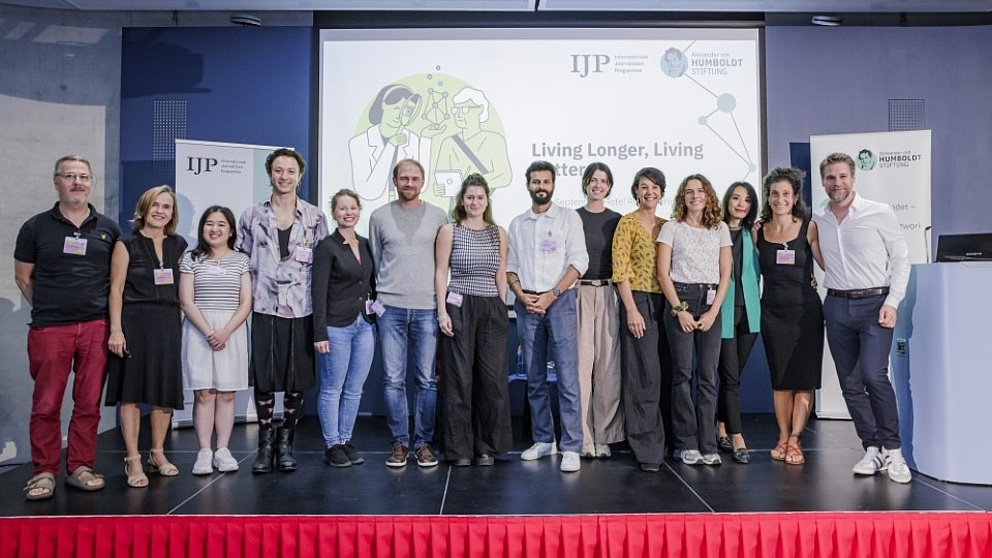
We should like to congratulate the five tandems whose project ideas impressed us with their particular focus on social benefits and innovative storytelling:
- Aaron Niederman (researcher) & Trisha Husada (journalist) and their project on the role of social technologies in workers’ alliances.
- Martyna Krajewska (researcher) & Florian Sturm (journalist) for their project on clean drinking water.
- Kirsten Traynor (researcher) & Jenna Kunze (journalist) for their project on the way nature reclaims militarised landscapes.
- Amritesh Kumar (researcher) & Tabitha Taylor Buck (journalist) for their project on less invasive medical implants in Parkinson’s research.
The peer award went to Shuyan Liu (researcher) & Sofia Christensen (journalist) for their project on loneliness amongst young people in Africa.
After publication, the projects will be presented on the Humboldt Foundation’s website.