
Jump to the content
- {{#headlines}}
- {{title}} {{/headlines}}

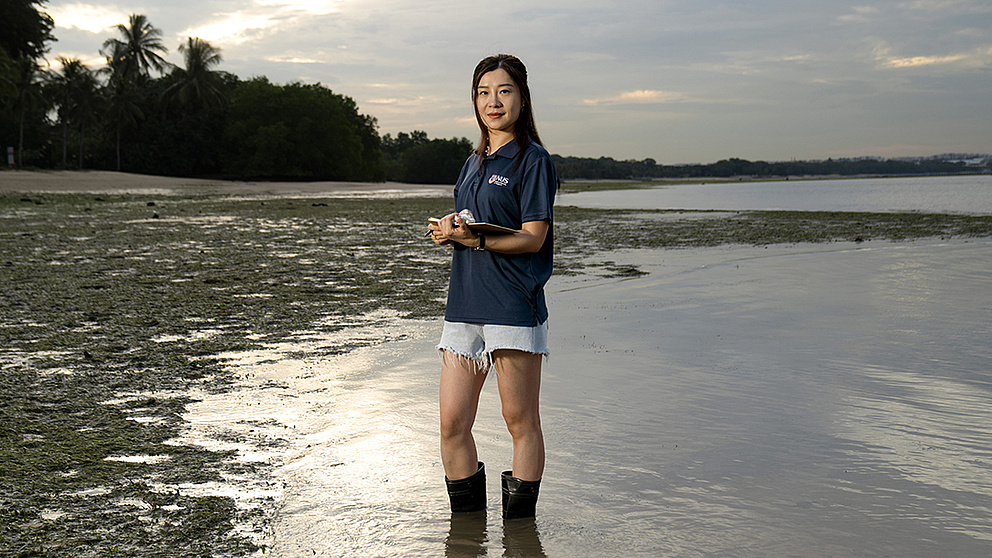
Dr Yuzhu Pearl Li from the National University of Singapore has been a Humboldt Research Fellow at the Leichtweiß-Institute for Hydraulic Engineering and Water Resources at TU Braunschweig since 2023. She is investigating something rather unusual as a measure for flood defense: oysters.
Flood defense powered by the sea
Sometimes, help comes from unexpected sources: For some 20 years, oysters have been becoming ever more prolific in the mudflats of the North Sea. Nowadays, these molluscs form veritable reefs. A blessing – because climate change is posing enormous challenges for coastal engineers. The risk of flooding and erosion is increasing, especially in these flat coastal areas. Flood defense and coastal management are thus becoming increasingly urgent tasks – after all, it is a matter of livelihood and safety for local residents.
How exactly do oyster reefs work?
The newly-formed reefs prevent sediments from being washed away and the coastline from eroding. The rough surface of these structures can withstand strong hydro-mechanical loads. “Oyster reefs are natural breakwaters,” says Yuzhu Pearl Li, and their growth continuously reinforces the protective effect.
“Reefs like this are also important habitats for marine animals and help to improve water quality by natural filtration,” she explains. “Stone and concrete breakwaters don’t have such advantages.”
3D printing and mathematics for innovative flood defense
Yuzhu Pearl Li is exploring how these advantages can be exploited for coastal protection and flood defense: For her experiments she and her colleagues use a 3D printer to recreate oyster reefs, arrange them variously in a wave channel and measure the effects. Using mathematical models, they scale their results so that they can estimate the large-scale impact on the seabed.
“As soon as we have found the ideal arrangement,” she says, explaining her aim, “we want to design artificial structures to encourage the oysters to settle” – along the coast of Germany as well as Singapore.