
Jump to the content
- {{#headlines}}
- {{title}} {{/headlines}}
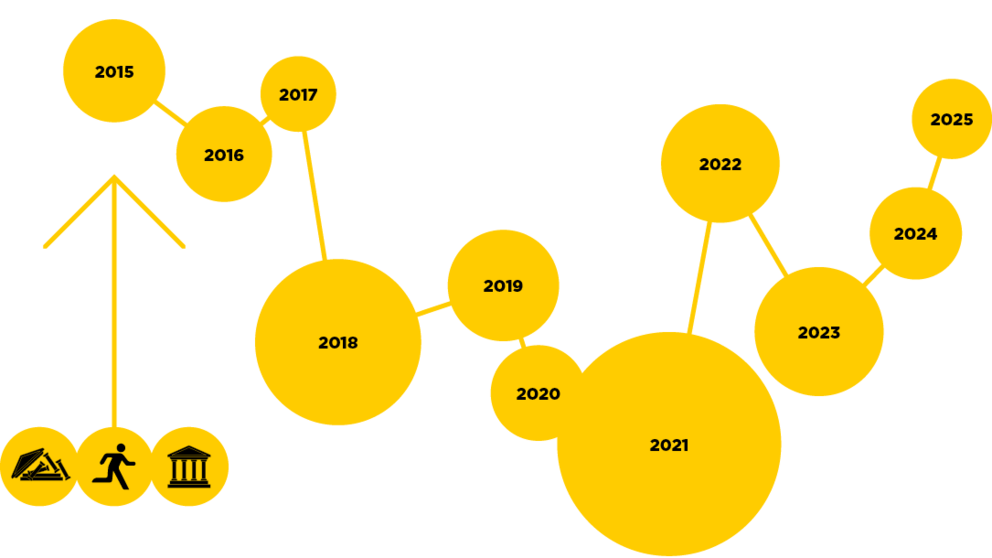
Philipp Schwartz Initiative: Chronology
The Philipp Schwartz Initiative: From its founding to the present day
| Summer 2015 | The Federal Foreign Office (AA) and the Humboldt Foundation announce the establishment of the Philipp Schwartz Initiative. From the very beginning, the partner organisations are the Scholars at Risk Network, the Council for At-Risk Academics and the IIEScholar Rescue Fund. | |
| June 2016 | First selection round – the first sponsorship recipients: 18 universities are selected to host 24 fellows from Syria, Turkey, Libya, Pakistan and Uzbekistan. | |
| September 2016 | Together with 20 academic institutions, the Foundation establishes the German Section of the Scholars at Risk Network that campaigns worldwide for academic freedom and researchers at risk. The Foundation hosts the secretariat for the German Section. | |
| June 2017 | International support for PSI: the American Mellon Foundation donates one million US dollars for additional fellowships. Up to 2025, Mellon has donated a total of three million US dollars to PSI. | |
| April 2018 | Together with FU Berlin and Scholars at Risk, the Foundation organises the Scholars at Risk Network 2018 Global Congress in Berlin. The worldwide SAR Network’s biennial meeting is held in Germany for the first time. | |
| September 2018 | The German Bundestag and the AA cement the programme: previously time-limited, the initiative now receives robust basic funding from the AA on a permanent basis. | |
| March 2019 | The Philipp Schwartz Forum becomes a platform for exchange and networking amongst fellows and host institutions as well as national and international actors on the protection of academic freedom and support for researchers at risk. | |
| October 2019 | The Foundation becomes involved in the EU-funded Initiative InSPIREurope (Initiative to Support, Promote and Integrate Researchers at Risk in Europe) to reinforce academic freedom and the protection of researchers at a European level. | |
| November 2021 | In response to the takeover by the Taliban, the Foundation sets up a special programme for the first time. The aim is to quickly support researchers affected, taking account of the particular situation in Afghanistan. | |
| March 2022 | After the Russian invasion, the AA, Gerda Henkel Foundation and the Stiftung Mercator facilitate special funding for Ukrainian researchers. Springer Nature and the Carl-Zeiss- Stiftung finance a PSI emergency fund Ukraine to provide immediate aid. | |
| July 2022 | The EU Commission creates the first fellowship programme for Ukrainian researchers at risk, MSCA4Ukraine, and tasks a consortium comprising SAR Europe, the European University Association and the Foundation with implementation. | |
| April 2023 | The special programme for Iran is developed in response to the protests there following the killing of Jina Mahsa Amini and the escalating persecution of researchers. | |
| 2023/24 | New networking formats: at the Humboldt4Ukraine series of events and a network meeting, the Foundation, the DAAD, the German Federal Environmental Foundation, the Gerda Henkel Foundation, Leopoldina, and Volkswagen Foundation bring together Ukrainian researchers, funding organisations, and politicians. They address the reconstruction of the Ukrainian science system and perspectives for researchers after the war. | |
| June 2024 | In a series of conversations on “Fragile Freedom”, PSI fellows report on their experiences and the conversations are turned into podcasts. The series is implemented by con gressa together with the Foundation and funded in the context of the BMBF’s 2024 Science Year “Freedom”. | |
| Support from third party funders | From the beginning, private donors supplemented the financing provided by the AA: the Alfried Krupp von Bohlen und Halbach Foundation, the Fritz Thyssen Foundation, the Gerda Henkel Foundation, the Klaus Tschira Foundation, the Robert Bosch Stiftung, the Stiftung Mercator, the Stifterverband, the Mellon Foundation, the Carl-Zeiss-Stiftung, Springer Nature, the Buschmann-Simon-Treuhandstiftung as well as several private individuals. | |
| Outlook | The Foundation wants to extend European cooperation on PSI. The aim is to provide greater support for the countries affected – such as Syria and Ukraine – not least with regard to possible reconstruction. |