
Jump to the content
- {{#headlines}}
- {{title}} {{/headlines}}

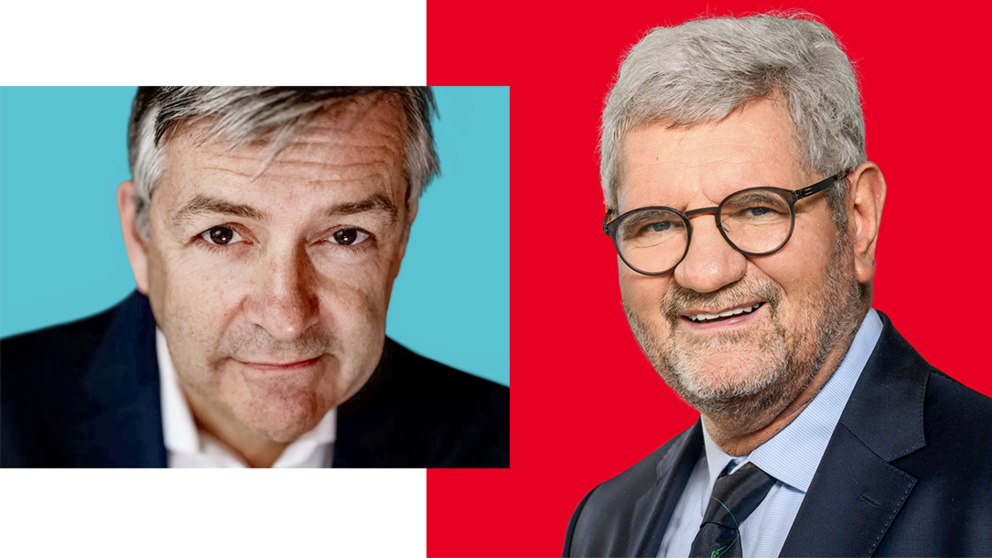
Robert Quinn is a lawyer, co-founder and Executive Director of the international Scholars at Risk Network (SAR), based at New York University. More than 600 academic institutions in over 45 countries belong to SAR. Robert Schlögl has been President of the Alexander von Humboldt Foundation since 2023. A chemist and internationally recognised expert on green energy and the energy systems of the future, he was previously director of the Fritz Haber Institute in Berlin. Both are strong advocates of academic freedom.
Status quo of academic freedom worldwide
Mr Quinn, current monitoring reports such as Free to Think and the Academic Freedom Index point to a decline in academic freedom worldwide. Are we seeing a global trend?
Robert Quinn: Clearly, yes, academic freedom is declining. Both datasets show rising pressure on institutions and individuals as the long-standing tension between power and ideas intensifies in times of political, social, and technological uncertainty.
And we are living in a time of overlapping uncertainty: climate stress, new geopolitical conflicts, migration pressures, economic inequalities, the aftermath of the pandemic, and now disruptive technologies like AI. These dynamics increase the impulse of some actors to suppress open inquiry – especially when questioning established authority becomes politically inconvenient.
What do you think are the causes of these developments?
Robert Quinn: The roots go back decades, but several contemporary forces have accelerated the trend. Whenever societies face instability, the tension between universities and the state tends to grow.
Today, in an atmosphere of overlapping uncertainty, there are two competing responses: Some people say, “This is complicated – let’s gather data and find solutions.” Others insist, “This is simple – let’s go back to how things were and stop listening to experts.” The latter sentiment fuels attacks on scientists, health professionals, social scientists, and humanists alike. These assaults are not just political reactions; they are emotional responses.
“Threats travel faster. Researchers everywhere feel the precarity of academic freedom more directly.”
What kinds of threat do researchers face today? What are infringements on academic freedom?
Robert Quinn: We see the full spectrum of threats – from mild harassment to imprisonment and even loss of life. Scholars at Risk focuses on the most severe cases: violence, persecution, and unjust imprisonment. Below that, there is targeted harassment – doxing, online abuse, intimidation, and sometimes physical danger. And even without direct attacks, the “chilling effect” is profound: fear, isolation, self-censorship.
We see this even in countries that still consider themselves safe in terms of academic freedom, such as the United States, where travel bans and political interference are growing. Ultimately, these threats don’t just harm individuals – they undermine universities’ ability to serve the public, to produce knowledge and to inform societal decision making.
Where is the situation regarding academic freedom most worrying?
Robert Quinn: Unfortunately, it affects every region. Our latest Free to Think Report documents 395 attacks in 49 countries. That includes:
- imprisonment,
- surveillance,
- exile in conflict-affected states,
- legislative interference,
- ideological restrictions and
- public harassment in democratic societies.
What has changed is public awareness: universities in Europe or North America can no longer assume that their operating space is inherently secure. The pressure to delegitimise expertise and evidence-based debate is increasing in many democracies.
Impact and achievements of the Philipp Schwartz Initiative
Mr Schlögl, the Philipp Schwartz Initiative (PSI) was launched ten years ago to support scholars facing persecution. How has reality changed since then?
Robert Schlögl: The Philipp Schwartz Initiative was launched in 2015 – in response to developments in the Middle East, particularly in Syria. Since then, the geography of threats has expanded dramatically: Russia, Ukraine, Afghanistan – as have the crises that have produced systemic risk to large academic communities.
What has also changed is our perception: threats travel faster. Social media ensures that fear spreads instantly; researchers everywhere feel the precarity of academic freedom more directly.
The latest hotspot where academic freedom is under pressure is the U.S. Are researchers from the U.S. already submitting requests to the Philipp Schwartz Initiative?
Robert Schlögl: We have received one inquiry from the United States to date. I want to make that very clear: In Germany, there is sometimes a debate suggesting that the situation in Russia and the United States is somehow comparable when it comes to academic freedom. But they are clearly not. Despite all the concerns and discussions we have, the differences are vast.
And then, of course, there is China, a country without academic freedom but with an enormous output from its science system. Isn’t that a contradiction?
Robert Schlögl: China is a particularly interesting case because the restriction of academic freedom there is, in a way, tolerated within the system due to its sheer size. When I speak to people, they often don’t associate the impact of China’s serious problems with academic freedom. The sheer scale of scientific activity and opportunity means that the oppressive aspects – the notion that the Communist Party controls everything in science – are barely felt.
Robert Quinn: I would add that one must distinguish baseline freedom from visible incidents. In China, the baseline is already low. Fewer repressive events do not mean more freedom – they mean repression is working efficiently. Meanwhile, in places like the U.S., the baseline was high, but the direction of change is now negative and accelerating.
“Scholars are rarely attacked for the content of a physics formula or a medical discovery – they are attacked for the act of questioning.”
We discussed regional differences. Are there also differences regarding research fields? Are certain research fields targeted particularly?
Robert Quinn: Academic freedom is under threat everywhere. It is a misconception that some disciplines are inherently “safe”. Scholars are rarely attacked for the content of a physics formula or a medical discovery – they are attacked for the act of questioning. Today, we see heightened risks in fields dealing with gender, identity, social justice, minority rights, and languages. These areas are used as political leverage points – not because of the research itself, but because it can be mobilised as a cultural symbol.
Robert Schlögl: Disciplines closer to political power or national security – molecular biology, nuclear physics, defence-related research – also attract attention. But the decisive factor is not the field; it is the proximity to contested issues. Where knowledge collides with ideology, risk arises.
The Philipp Schwartz Initiative works closely with programmes such as Scholars at Risk and the Scholar Rescue Fund. How does this cooperation work?
Robert Schlögl: It is foundational. The Philipp Schwartz Initiative would not be effective without the international networks that identify and assess cases. Scholars at Risk provides expertise, early warning insights, and global advocacy networks. Our cooperation ranges from practical matters, such as assessing risks, to joint public engagement for academic freedom.
Robert Quinn: Collaboration is not just operational – it is strategic. The defence of academic freedom must be transnational because threats are transnational. The Philipp Schwartz Initiative is a cornerstone partner in that effort, including in European-level projects to safeguard academic space.
In Germany, universities host PSI fellows. After ten years, would you like to highlight some of those that have been particularly helpful during this time?
Robert Schlögl: No – and that is a strength. Over 140 universities and research institutions have hosted PSI fellows, so support is widely distributed. Nor do we experience institutional hesitation, such as “This is too risky or too political.” That is remarkable – and it is not guaranteed to remain so if political attitudes towards science shift.
„Science is not 'nice to have' or a luxury. It’s the baseline of a living society.“
That’s exactly why many people discuss resilience in our German science system. What responsibility do scientific institutions, but also politicians bear in countering scepticism and hostility?
Robert Quinn: Universities have a responsibility to articulate what academic freedom is and why academic freedom matters. Not in abstract constitutional terms – but as something intimately connected to the quality of everyday public life. The narrative cannot be: “Support us because we are important.” The narrative must be: “We serve society by helping it navigate uncertainty.” And that service sometimes requires courage.
Robert Schlögl: In Germany, I see a political trend to treat science as optional – something to fund if resources permit. Some politicians have the impression that we need to pay more attention to defence and social issues.
But science is not “nice to have” or a luxury. It’s the baseline of a living society. This development is dangerous. Freedom of science is the indicator of freedom of society. When that indicator is weakened, society loses its orientation.
The future of academic freedom
Finally, let’s look ten years into the future. What would it take to achieve a renaissance of academic freedom?
Robert Quinn: The most important factor is visible support for those under threat. Protecting targeted scholars gives others courage, while abandoning them spreads fear. Academic freedom needs legal safeguards, strong institutions, and cultural legitimacy – but above all, people who dare to think.
I strongly endorse the idea of renaissance, not just for higher education but for humanity guided by the ideals of truth, beauty, culture, and dignity. Universities must help society navigate complexity and defend nuance in a world where media and technology often undermine it. Programmes like the Philipp Schwartz Initiative are vital because they save lives – and they sustain the courage others need to keep thinking freely.
Robert Schlögl: And scientists must embody confidence. We should not retreat into cynicism or defensive self-justification. Science can model how to live constructively with complexity and disagreement. If we communicate that – not only through policy papers, but through human example – society will rediscover why it needs us.
This interview on academic freedom was conducted by Table.Briefings editor, Tim Gabel, and originally appeared in Research.Table.