
Jump to the content
- {{#headlines}}
- {{title}} {{/headlines}}

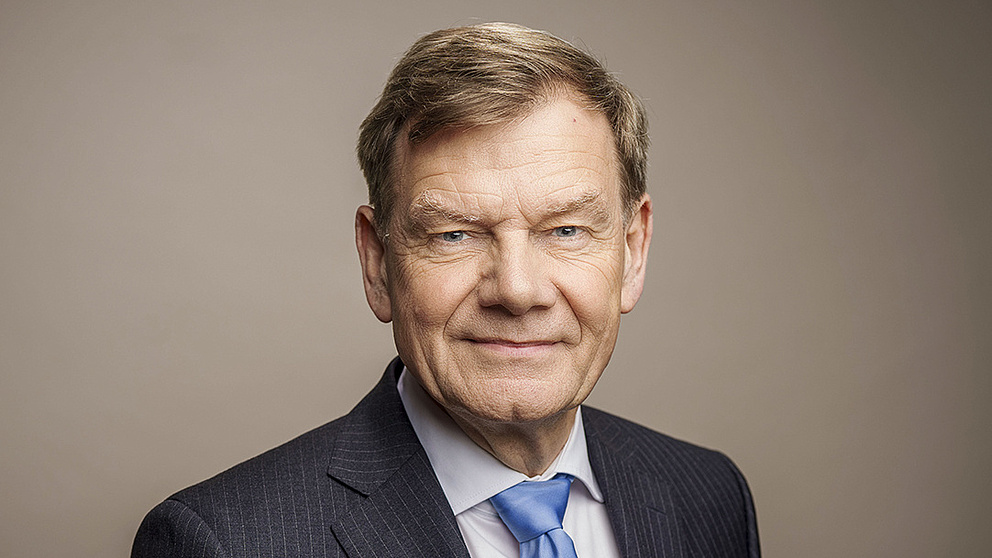
Johann Wadephul has been Federal Foreign Minister since May 2025. In 2015, the Federal Foreign Office and the Humboldt Foundation jointly launched the Philipp Schwartz Initiative, which takes in endangered academics from abroad. Wadephul emphasises the importance of the programme as a contribution to supporting persecuted researchers – and to protecting academic freedom.
Johann Wadephul on the namesake Philipp Schwartz
I recently had the opportunity to look at some papers from the estate of Philipp Schwartz. They included a small booklet entitled “Notgemeinschaft”. In the preface to the brochure, Schwartz describes the day before he fled Frankfurt:
“On 23 March 1933, a Monday morning, I bumped into my colleague A.W. Fischer (…) in the garden of the Municipal Hospital in Frankfurt am Main. He was very concerned and asked me why I hadn’t ‘gone on a trip yet’. I should leave immediately, otherwise I would be arrested. (…) I was ready to go.”
A few days before, the police had searched Schwartz’s house, supposedly looking for machine guns. Schwartz was a pathologist, the youngest professor in Germany at the time, who taught at the University of Frankfurt. He was also Jewish. For the National Socialist regime in Germany this was reason enough to drive him into exile.
Philipp Schwartz in exile – the beginning of a protection initiative
He initially stayed with relatives in Zurich from where he observed the situation in Germany: “And then, every day, there were these dreadful reports about suspensions, expulsions, arrests, ill treatment and suicides of university staff all over Germany. As early as the beginning of April, one encountered colleagues everywhere in Zurich who would normally have been fulfilling their teaching commitments in Frankfurt am Main, Berlin or Würzburg. (…) We had to try to stem the panic and get organised.”
“Alongside his research, it became Schwartz’s life’s work to enable persecuted scholars to conduct their research in freedom.”
Schwartz founded the ‘Emergency Society of German Scholars Abroad’, an association of more than a thousand German university staff who had been persecuted and displaced by the National Socialists. It supported researchers who had fled Germany, found them jobs, gave them prospects. Ernst Reuter, amongst others, had the Emergency Society to thank for his emigration to Turkey. Alongside his research, it became Schwartz’s life’s work to enable persecuted scholars to conduct their research in freedom.
Johann Wadephul sees a special responsibility
Against the backdrop of our history, I believe we Germans have a very special responsibility. We want to assume this responsibility and see it as our duty to honour people like Philipp Schwartz and, in a certain way, to continue their work.
“Academic freedom quite rightly enjoys constitutional status in Germany.”
Because we are currently living in a world in which systemic attacks on scientific freedom are increasing – in Europe, too, by the way, and in the transatlantic area. Freedom of science quite rightly enjoys constitutional protection in Germany and is an important principle of our international university and academic cooperation.
Significant impact with the Philipp Schwartz Initiative
This is why, ten years ago, the Federal Foreign Office sent a clear message and established the Philipp Schwartz Initiative (PSI) a German protection programme for international researchers at risk.
- Together with the Alexander von Humboldt Foundation, our initiative enables German institutions of higher education, universities and research institutes to host international researchers who are threatened by war or persecution in their own countries for a certain period of time.
- This is not only of benefit to academic life in Germany and to the country as a location for research, but is also designed to ensure that the researchers continue to be members of the global scientific community and are able to pursue their research and network with others.
- Over the past ten years, more than 600 fellows from over 30 countries have been sponsored both in the regular programme, as well as in special programmes for Afghanistan, Iran and Ukraine.
Focus on the individual fates of the sponsorship recipients
I would like to express my sincere gratitude to the Alexander von Humboldt Foundation for its enormous commitment, which makes a crucial difference to defending scientific freedom.
Just how important this initiative is, becomes clear when we take a look at the fates of the sponsorship recipients, for example, the Afghan legal scholar Suhailah Akbari, who was immediately threatened when the Taliban seized power in 2021 and had to flee the country with her two daughters. After days of uncertainty and fear at Kabul Airport, she managed to escape to Germany with German assistance. As a Philipp Schwartz Fellow at Humboldt Universität zu Berlin she has been able to resume her research on the legal framework for climate policy and trade in clean energy, in other words, on forward-looking topics that will be needed for a hopefully more stable Afghanistan in the future, as returning and helping to build the social and economic stability of the countries involved are fundamental principles of the initiative.
Johann Wadephul appeals to actively promote academic freedom
At the end of his life, Philipp Schwartz also thought about the future: “Let us try to show our successors in the coming generations that during one of the darkest periods in history and contrary to the intentions of the German destroyers, new ideas and achievements whose roots were to be found in German soil significantly paved the way for a happy future.”
“Knowledge is the greatest asset in our societies. Let us not waste it, but instead actively protect and promote it.”
I wish all the fellows and alumni of the Philipp Schwartz Initiative a happy future. We want to play a role in preserving their ideas and achievements and in helping them to continue developing their potential in a safe environment. We know what efforts they have had to make and continue making every day. Knowledge is the greatest asset in our societies. Let us not waste it, but instead actively protect and promote it.
Johann Wadephul