
Jump to the content
- {{#headlines}}
- {{title}} {{/headlines}}


Contact
Press, Communications and Marketing
Tel.: +49 228 833-144
Fax: +49 228 833-441
presse[at]avh.de
In times of global political tension, the Humboldt Foundation is keen to continue expanding and intensifying dialogue between academia, society and policymakers. Humboldt sponsorship recipients will be deployed to political institutions, contributing their specialist expertise and perspectives in various dialogue and exchange formats. The aim of the Humboldt Placement Scheme is to make the knowledge in the Foundation’s network available to decision-makers and advisors. At the same time, researchers and political stakeholders will benefit from insights into the way the other side works.
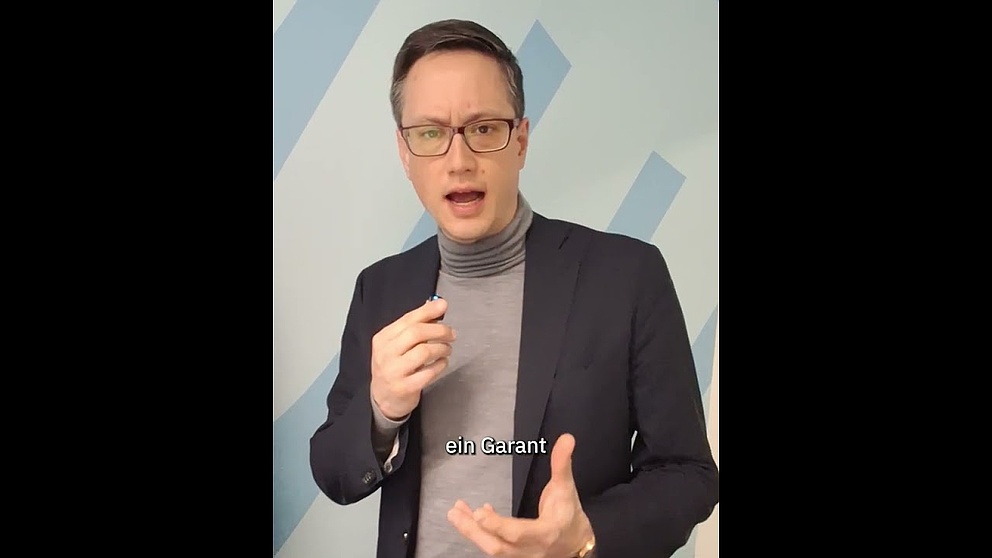
As part of a pilot for the new Humboldt Placement Scheme, the first Humboldt Foundation alumnus embarked on his stint at the Federal Foreign Office at the beginning of November 2025. Michael Laha, transatlantic expert, was a German Chancellor Fellow at the Mercator Institute for China Studies (MERICS) in Berlin from 2021 to 2022. He is now spending three months at the Federal Foreign Office as an exchange partner on issues of international science policy.
The president of the Humboldt Foundation, Robert Schlögl, sees great potential in the Humboldt Network to have an impact in the field of science policy: “In the context of classical science diplomacy, the Humboldt Foundation stands for the mediation of values of freedom and the utilisation of individual, trusting contacts in communications between states, especially when official channels have ceased to function. Every year, we bring about 900 of the world’s brightest minds to Germany. Their expertise is also of major interest to political decision-makers. In order to reinforce knowledge transfer between science and policymakers we have developed the Humboldt Placement Scheme.”
For the Federal Foreign Office, this form of policy advise is a vital basis for tackling global challenges jointly and responsibly.
The Federal Foreign Office considers this cooperation a great opportunity for both sides. Anke Reiffenstuel, Commissioner for Foreign Science Policy, Foreign Education and Research Policy at the Federal Foreign Office, emphasises, “We are looking forward to the exchange with Mr Laha and his input for our science diplomacy. Strong, independent, internationally connected science is a central pillar of well-functioning relations with other states and societies. The Alexander von Humboldt Foundation and its network play an indispensable role in deepening the dialogue between research, society and policymakers, thus reinforcing evidence-based decision-making. For the Federal Foreign Office, this form of policy advise is a vital basis for tackling global challenges jointly and responsibly.”

The Humboldtian Michael Laha is currently a senior research fellow at the Center for Geopolitics, Geoeconomics and Technology in the German Council on Foreign Relations (DGAP). He addresses China’s research and technology policy and the role of China in transatlantic relations. Looking ahead to the collaboration, he says, “I am very much looking forward to the change of perspective and to being able to contribute to the cooperation with my expertise in research and policy. Not least, it’s about reinforcing understanding for the ways both sides work and operate. How do scientific findings inform decision-making processes? What are the questions that drive political decision-makers and how can research help to find solutions? It’ll be an exciting time which will undoubtedly give me lots of new ideas for my own work, too.”
After the programme pilot, a second phase of placements in embassies and the German Bundestag is planned in 2026.
Very much in line with its Strategy 2024 – 2028, the Humboldt Foundation wants to strengthen research in turbulent times. Stable international science policy is an important building block for resilient science in a changing world.