
Jump to the content
- {{#headlines}}
- {{title}} {{/headlines}}
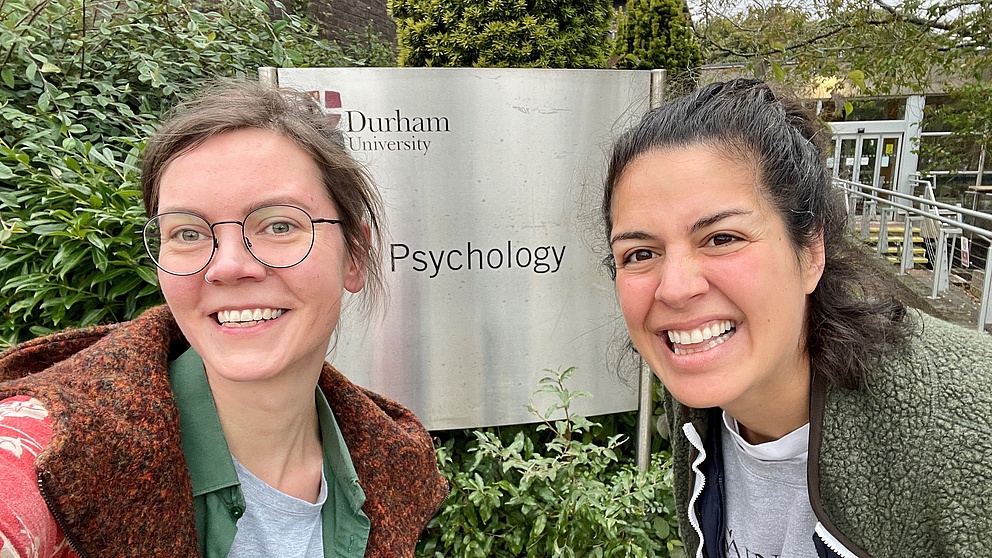
At the University of Durham in the United Kingdom, Sheina Lew-Levy’s research group employs both quantitative and qualitative methods to investigate how - and from whom - children learn by participating in daily social life. The focus is on the egalitarian BaYaka community, who live in the rainforest of the northern Republic of the Congo. Among the BaYaka, children teach one another the essential skills needed to contribute to their community’s food supply. This research combines fieldwork with interdisciplinary approaches from anthropology, psychology, and educational studies.
Understanding and Investigating Collaborative Networks
Friederike Hillemann was captivated by Sheina Lew-Levy’s research on the BaYaka and inspired to explore similar questions about human collaborative networks. Together, the two researchers now aim to understand the evolution and cultural diversity of social learning and cooperative networks in hunter-gatherer societies and other Indigenous communities, especially under specific ecological and cultural conditions.
“Through the cooperation of individual members, small networks emerge—networks that communities rely on to survive. Just as in academia, individual researchers depend on their peers to advance their own work,” explains Lynen Fellow Hillemann. This, they agree, is particularly true for women and other underrepresented groups in science.
Barriers for Women in Academia
“Women in science still face structural barriers,” Hillemann summarises. “One example is the deeply entrenched tradition of ‘old boys clubs’, where men exchange ideas in informal, exclusive circles—while women are largely excluded.”
Host researcher Lew-Levy also points to practical obstacles that make it harder for women to pursue academic careers, such as the persistent expectation that they bear primary responsibility for childcare. This is especially true in fieldwork, where adequate childcare is often unavailable, presenting female researchers with considerable financial and logistical challenges. In such cases, targeted support can make a significant difference—through financial assistance or flexible fellowship conditions, for instance.
A Shared Path Through the Lynen Fellowship
The two researchers first met in 2021 at the Max Planck Institute for Evolutionary Anthropology in Leipzig, where Lew-Levy was conducting research as a Humboldt-Research-Fellow herself. Inspired by Lew-Levy’s positive experience, Hillemann decided to apply for a Lynen-Fellowship from the Alexander von Humboldt Foundation, with the goal of learning from her host’s expertise and implementing her own research project in collaboration with colleagues in Leipzig and Durham.
Both researchers value not only the financial support provided by the Humboldt Foundation, but especially the intellectual freedom that distinguishes the Lynen Fellowship from other funding programmes.
“The Foundation supports individuals with ambitious ideas and potential, rather than rigid project plans. That gives you the freedom to think boldly—to engage in so-called ‘blue sky thinking.’”
This freedom is crucial. As a PhD student, one may have time to do research, but often lacks the skills and experience; as a university employee, one may have the expertise, but less time due to teaching and administrative duties. The Lynen Fellowship enables research that transcends disciplinary and national boundaries—and fosters collaboration that is essential for both science and society.
Together, Not Alone: A Call for a New Scientific Culture
Both researchers advocate for greater solidarity and support within academia. They envision a culture that allows for learning from failure, where people help one another climb the proverbial rope rather than compete to reach the top alone. Lew-Levy and Hillemann agree: careers in academia are often unpredictable and challenging. This makes it all the more important to build networks that allow for shared success, mutual learning, and collective support.
“Working with my peers has brought me the most important ideas and projects.”
She advocates for a culture of horizontal collaboration in networks rather than vertical career climbing. “When you have people around you with whom you can also share setbacks and failures, you can be your true self. That’s much better than constantly feeling the need to impress. You’re more creative when you feel grounded within yourself,” both researchers agree—because this strengthens science as a whole.


Kontakt
Presse, Kommunikation und Marketing
Tel.: +49 228 833-144
Fax: +49 228 833-441
presse[at]avh.de