
Jump to the content
- {{#headlines}}
- {{title}} {{/headlines}}
Speed in the natural sciences
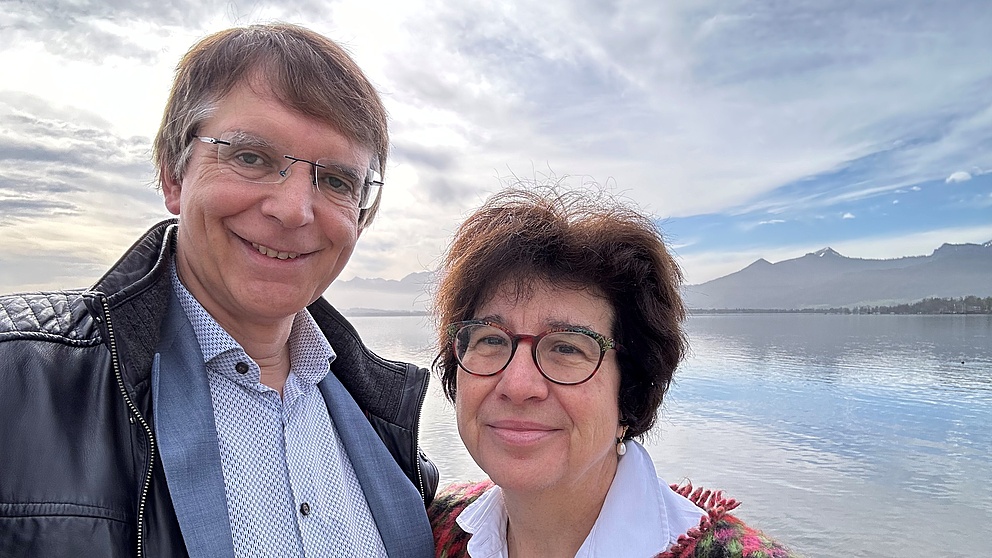
“In my subject, speed is everything,” says Martina Havenith-Newen, putting it in a nutshell. “When you come across really good postdocs at a conference you have to be able to offer a quick decision because we are competing with the best locations in the world, so otherwise people go elsewhere,” the top physicist from Bochum explains. The Henriette Herz Scouting Programme enables hosts to quickly issue an invitation to their chosen candidates. Once the scout’s recommendation has been formally approved, a Humboldt Research Fellowship can be granted.
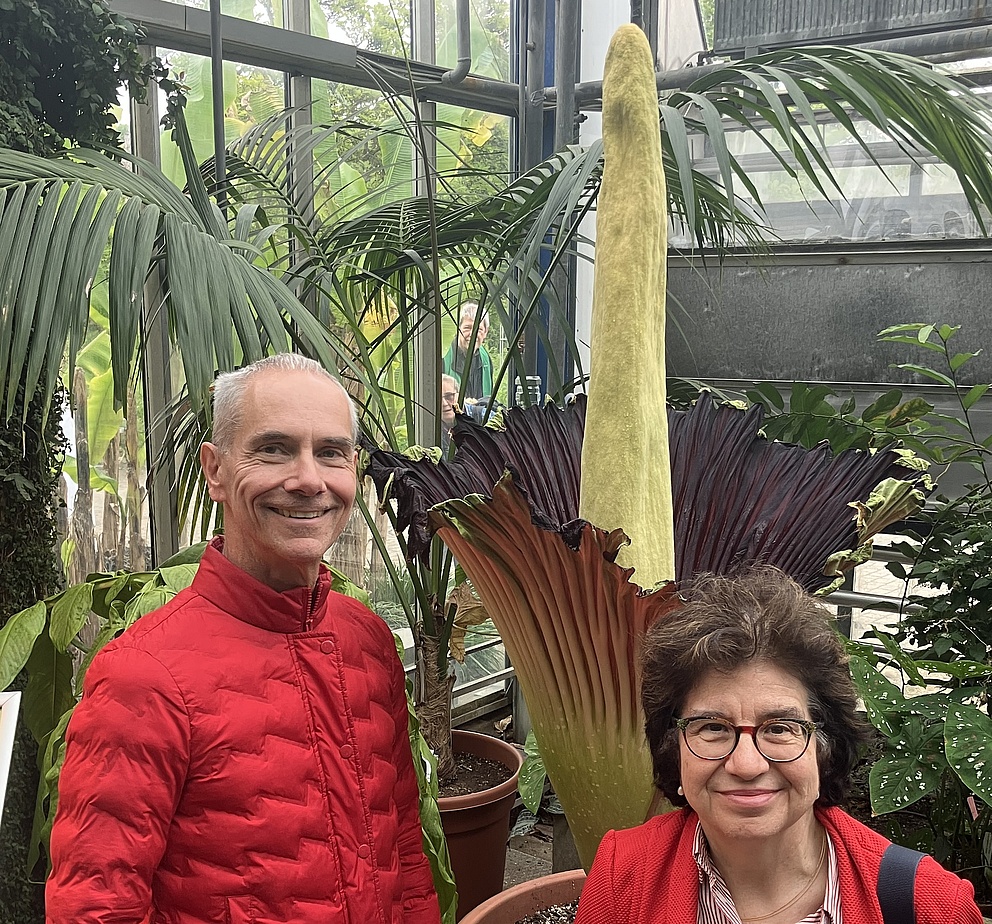
The physicist has held the professorship in Physical Chemistry II at Ruhr-Universität Bochum since 1998 and is the director of the Center of Molecular Spectroscopy and Simulation of Solvent Controlled Processes (ZEMOS). Here she investigates how water molecules behave when they encounter solvents. Using terahertz spectroscopy and high-resolution infrared spectroscopy Havenith-Newen and her team are able to observe the movements of individual water molecules in real-time experiments, that is, with a time constant of a billionth of a millisecond.
Through her work in an alliance with other regional research institutions in the RESOLV cluster of excellence, she has helped to make the Ruhr Area into a world leader in solvent chemistry – a status confirmed by many national and international awards for RESOLV researchers.
The research conducted by Havenith-Newen and her colleagues will potentially play an important role in the future of the planet and decarbonisation because a “microscopic” understanding of solvents and their effects opens up new perspectives for more efficient responses and thus for reducing the carbon footprint in industry.
New opportunities for the humanities
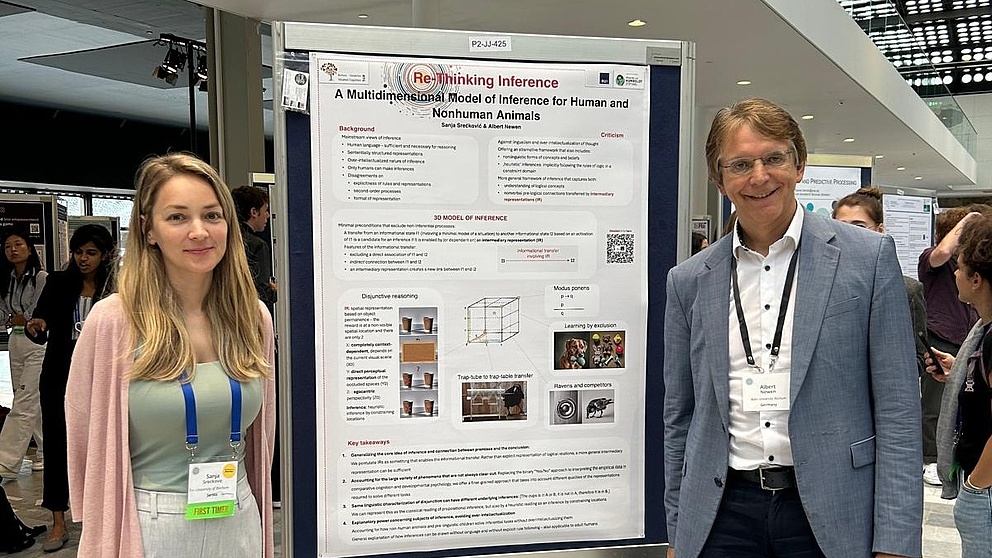
“The situation in the humanities is a bit different. Here I think the programme helps to catch the people who would otherwise never have considered Germany,” says philosophy professor Albert Newen, like the postdoc originally from Iran who did a doctorate in the United States and now works together with Newen.
“Apart from this, my role as a scout means I can recruit female junior researchers who wouldn’t have applied or dared to pit themselves against worldwide competition in the usual application process,” explains the co-author of The Oxford Handbook of 4E Cognition.
The professor of philosophy with a focus on the philosophy of mind reports on the case of a Serb researcher he successfully scouted for a research fellowship in Bochum. “She has enormous potential, but she would have failed in an application process due to the language barrier. Half her publication list was in Serbian; there were too few articles in English; it wouldn’t have been enough,” he knows. Host and mentee have already submitted their first joint publication to a specialist journal.
Both partners confirm that the Henriette Herz Scouting Programme is an important tool for introducing women into cutting-edge research or keeping them there. “I regularly hear my female postdocs saying, ‘I didn’t think I was good enough,’” says Martina Havenith-Newen who became the first woman to hold a chair in natural science in Bochum just over a quarter of a century ago.
Family, career and the path to a dual career
Both professors are taking part in this interview online from Bochum. Anyone who has ever lost their way around the enormous RUB campus knows how far it is from ZEMOS on the eastern edge of the site to the Department of Philosophy in Building GA to the west of the Audimax. During a stressful period with two small children, it was unclear for a long time whether they would ever manage to live in the same place and both pursue their careers.
“For years, we commuted. My wife was in Bochum, and I was originally in Bonn and then got my first professorship in Tübingen,” Albert Newen remembers. “We had two sabbaticals in three years, one in Oxford and one in the US, just to be together as a family in one place,” he continues.
When Martina Havenith-Newen received an offer from Emory University, Atlanta, US, which immediately included her husband and the needs of the family as well, the then rector of Bochum reacted promptly: “Now or never!” Newen had just managed to acquire a major third-party interdisciplinary project with the Volkswagenstiftung and took it with him to Bochum. “At that time, dual career was still an unknown quantity at German universities, like so many things. I had to keep pressing for a university daycare centre,” Havenith-Newen explains. “I told the university management that equal opportunity was not just supposed to be an ideology, but that practical assistance was essential. Nowadays, new professors benefit both from dual career schemes and the university daycare centre. Both these things are core arguments for the location and reduce the danger of top researchers being lured away,” Havenith-Newen is still delighted to report many years later.
Philosophical research on the Self and the strength of networks
Her husband, Albert Newen, is working on a philosophical model of the Self which explores how our model of ourselves and memories influence each other. In the course of our lives, our memories of a particular episode change. A person who is capable of self-expression integrates their different memories into a coherent concept of identity. So, we are constantly rewriting our own history, adapting it to the current model of ourselves.
Just like his wife, Albert Newen has repeatedly benefited from the Humboldt Network. Whilst the family was young, it was difficult for the researchers to be mobile. “I was 42 before I was able to go to the US for the first time; for our first joint sabbatical. Before that, it was important to get people from abroad with new ideas to come here,” he remembers. Thanks to his research awards, he was able to recruit a sparring partner from Stanford for his habilitation in the Humboldt Network. “These professional additions and collaborations with high-ranking personalities in the US and Italy at that time developed into lifelong friendships. When our Humboldt collaborative partners come to Germany today, they stay with us in Bochum,” Martina Havenith-Newen adds.
Diversity as a key to the future of science
For both of them it is important to think outside the box and enable talented people from countries that are not so well represented in the network to connect with science. “Diversity is indispensable for maintaining the broadest possible talent pool,” the leading physicist comments.
“Through the Scouting Programme,” says the philosopher, Albert Newen, “the Humboldt Foundation provides the parameters that are precisely the boost some talents need to take off. Of course, after that they have to fly themselves.” Being experienced hosts, this is something they are quite sure about. All the postdocs they have mentored so far have gone on to permanent positions in the most diverse places in the world. This pioneering research couple illustrates the role played by scouts in strengthening the Humboldt Network and promoting diversity.
