Jump to the content
- {{#headlines}}
- {{title}} {{/headlines}}
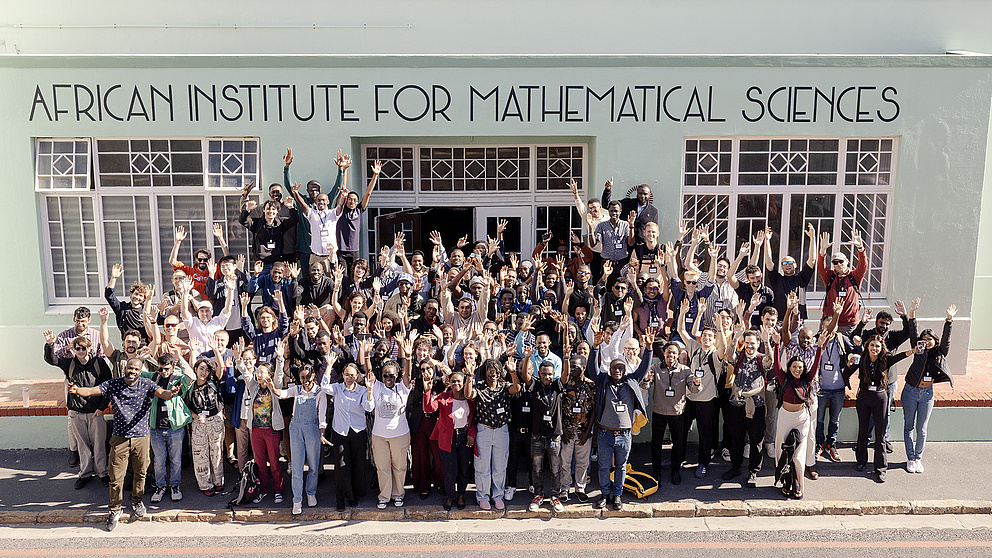
The first DAAD-funded AIMS workshop by Ryan Sweke took place from 27 to 30 October 2025.
The theme of the workshop was ‘The Theory of Quantum Learning Algorithms’.
Link to the event page: 1st AIMS Workshop and School
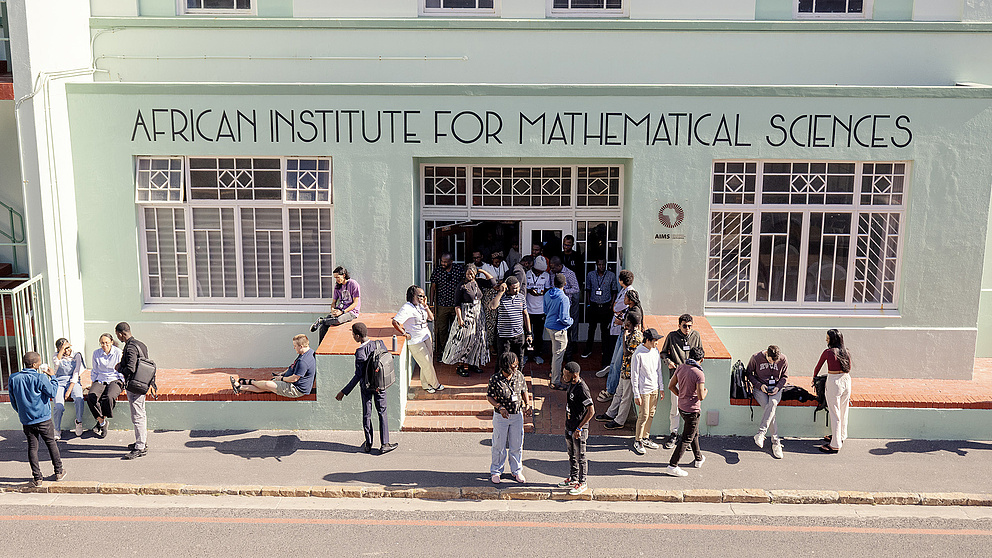
Dozens of researchers in intersecting fields are in the seaside town Muizenberg, South Africa, for the 1st AIMS Workshop and School on The Theory of Quantum Learning Algorithms. And while surfers ride Muizenberg’s world famous waves just outside, on the AIMS campus researchers and students from around the world are unpacking the latest developments in quantum learning algorithms, and plotting the path forward.
“Quantum computing and especially quantum learning has a very important role to play in the future because at its most fundamental level nature is quantum mechanical,” explains Sweke who has held the German Chair at AIMS South Africa, funded by the BMFTR and supervised by the Humboldt Foundation, since early 2025 and organised the workshop. “If we're to learn about the quantum world around us, if we're to develop new materials, new medicines, it's essential that we gain a very good understanding of the fundamental world around us.”
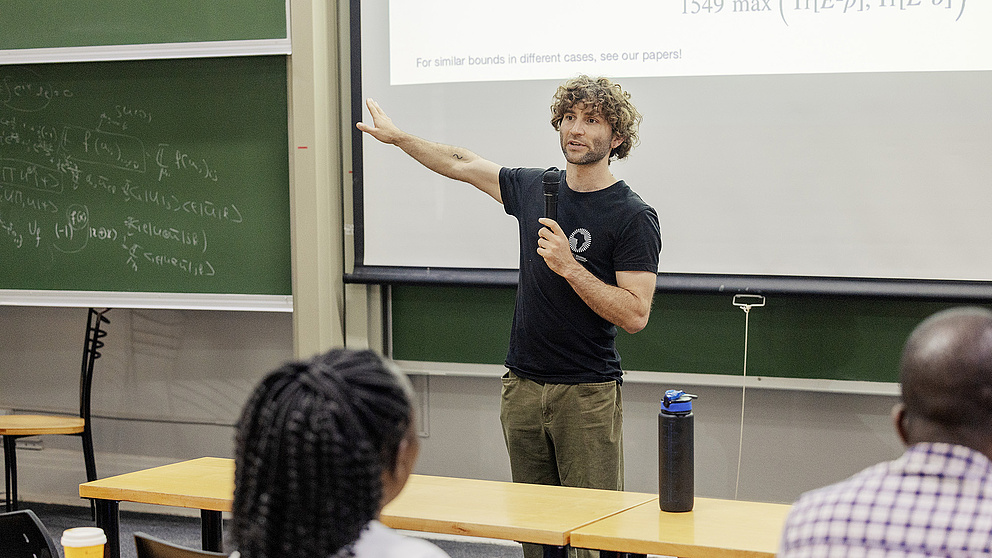
Meeting of cutting-edge researchers offers networking opportunity at AIMS South Africa
The AIMS South Africa Research Centre was launched in 2003, part of a network of centres of excellence across the continent. Over 1,000 African students pass through its doors since, living and working together on campus. The Alexander von Humboldt Foundation supports “German” chairs in various countries, including Rwanda, Ghana, and Senegal. The funding is aimed at strengthening both pan-African exchange and cooperation between African countries and Germany.
Complementing this, the DAAD promotes cooperation between German universities and AIMS centers that host an AvH-funded chair. The aim of the programme is to conduct research in collaboration with the respective chair holders and to support early-career researchers in the field of mathematics.
“We’re a community,” says Sweke. “We want to develop together as a community and so we live together, we work together and we support each other in our growth.”
“I love the atmosphere here at AIMS,” said Mina Doosti, an invited speaker from the University of Edinburgh. The participants’ enthusiasm, she said, was palpable: “People are here because they care about this field, they care about science, they want to learn, they want to understand – and there's no better place to be than a place like this to do science and to have scientific conversation.”
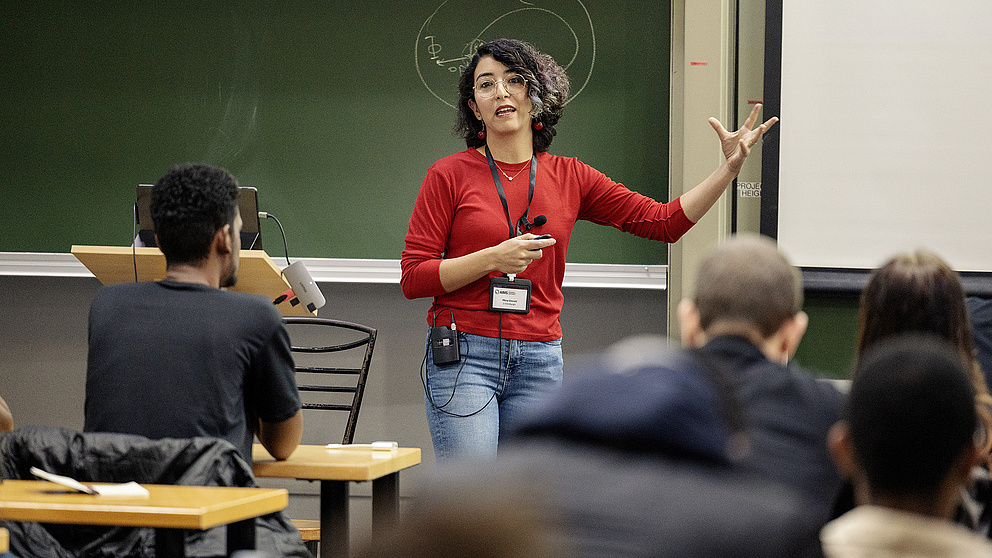
Interdisciplinary collaboration was also essential to progress in the field.
“You really need insight from mathematicians, from physicists, from computer scientists,” said Doosti. “When all these people come together, magic happens.”
Exchange across borders strengthens research
Lorenzo Leone, assistant professor at the University of Salerno and delivering a lecture on the Clifford Group and its applications, agreed, saying he quickly felt swept up in the warm and welcoming atmosphere of the workshop.
“I think it’s so special because it has the objective of collecting a lot of people and a lot of students from all around Africa,” said Leone of the workshop. “I think that the progress of mathematics and machine learning without the international exchange would be much slower. This workshop conference allows us to progress much faster and to develop more mature questions in the field.”
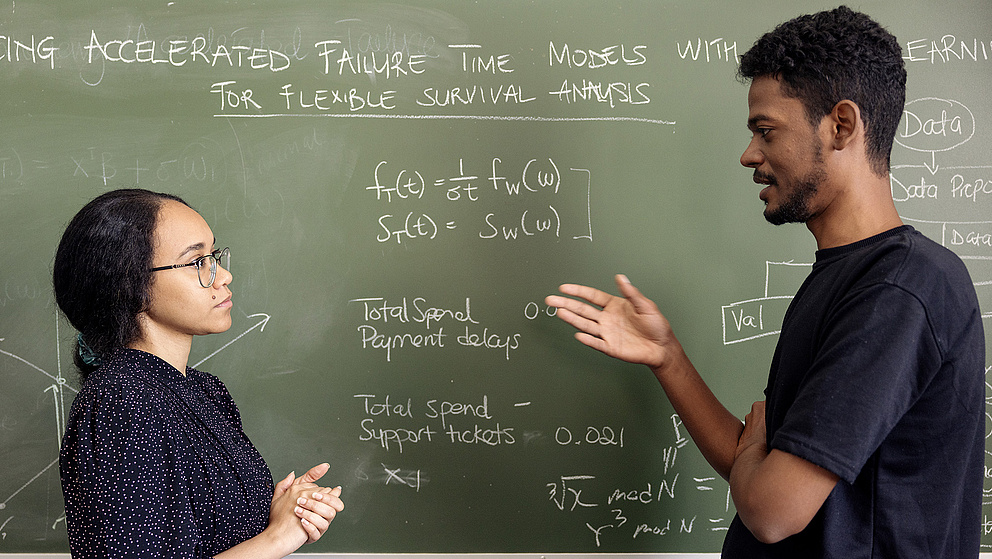
Returning AIMS student Zephrina Aniska said that her time at the centre had clarified her professional goals in pursuing research in quantum computing.
“I had never traveled outside in my country Madagascar before,” said Aniska. “So I really benefited from making friends with other African researchers.”
Teamwork as the key to scientific excellence
Ultimately, said FU Berlin professor in quantum physics Jens Eisert, the questions facing quantum computing were just too difficult for one person to solve on their own. As a veteran of the field, it was exciting to see “the gospel of quantum computing” spread through the African scientific community – and AIMS providing a space for the “crystallization of scientific excellence” in an atmosphere that was at once warm and focused.
“We need to bring together different heads, different backgrounds, different minds to realistically tackle the questions,” said Eisert.
It’s also just a lot more fun to work together in a team.